The Laboratoire Spécification et Vérification (LSV) is the computer science laboratory of ENS de Cachan. It is affiliated to the French Centre National de la Recherche Scientifique (CNRS) since its creation in 1997, and beneficiates of the support of INRIA since 2002. The laboratory currently employs 24 permanent researchers, 19 doctorate students, 8 associated researchers, and 6 administrative and technical support members.
Internship and PhD proposals are regularly posted by LSV researchers on our themes.
LSV devotes most of its research efforts to the study of the specification and verification of critical systems. The aim is to develop languages and formal methods for expressing and proving correctness of those systems. This sometimes leads to the development of tools for automatizing correctness proofs or finding bugs.
The laboratory is structured around five research axes, corresponding to five applications of our techniques:
The SECSI and DAHU axes are also affiliated with INRIA Saclay - Île-de-France.
We apply our results in tight collaboration with industrial partners such as Alcatel, Électricité de France, France Télécom, STMicroelectronics, etc.
Since Nov. 2006, LSV is a member of institut Farman, which gathers five laboratories of ENS Cachan around modeling, simulation and verification of complex systems.
the scientific report for the coming years 2010--2013
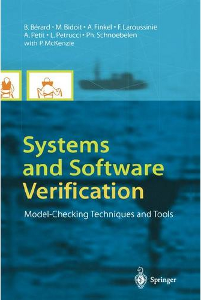
the LSV book: Systems and Software Verification. Model-Checking Techniques and Tools
| • | . Quantified CTL: expressiveness and model checking. Research Report LSV-12-02, Laboratoire Spécification et Vérification, ENS Cachan, France, 2012. 16 pages. ( PDF | BibTeX ) |
| • | . Lexical Disambiguation in LTAG using Left Context. In LTC'11. 2011. ( Web page | BibTeX ) |
| • | . Interrupt Timed Automata: verification and expressiveness. Formal Methods in System Design 40(1), pages 41-87, 2012. ( PDF | BibTeX ) |
| • | . An optimal construction of Hanf sentences. Journal of Applied Logic, 2012. To appear. ( PDF | BibTeX ) |
| • | . Bounded underapproximations. Formal Methods in System Design, 2012. To appear. ( PDF | BibTeX ) |